


IonQ, Inc. is at the frontier of quantum computing, using trapped-ion technology to develop highly accurate quantum systems. Since going public via a SPAC merger in 2021, IonQ has shown explosive revenue growth, expanding its industry reach and partnerships. However, profitability remains distant, and high R&D spend, insider selling, and valuation concerns cloud the short-term picture. This report offers a 360-degree analysis on IonQ’s financials, growth trajectory, order book, risks, market opportunity, valuation, and technical indicators, answering: Is IonQ a revolutionary moonshot or a risk-heavy bubble?
📈 Company Growth and Financial Performance
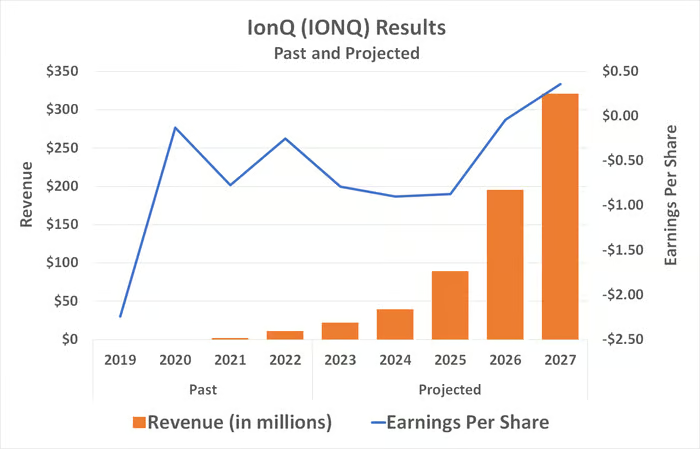
Revenue Growth Trajectory (2021–2024)
- 2021 Revenue: $2.1M
- 2022 Revenue: $11.1M (+428% YoY)
- 2023 Revenue: $22M (+98% YoY)
- 2024 Revenue: $43.1M (+95% YoY)
📌 IonQ has shown consistent exponential revenue growth, reflecting growing industry acceptance and early-stage commercial traction.
EBITDA and Profitability
| Year | EBITDA Loss | Net Loss | EPS |
|---|---|---|---|
| 2021 | -$38M | Not reported | NA |
| 2022 | -$75M | NA | NA |
| 2023 | -$126M | -$147M | -$0.69 |
| 2024 | -$213.8M | -$331.65M | -$1.56 (↓124.72% YoY) |
- Operating costs are ballooning due to cutting-edge R&D, scaling challenges, and workforce expansion.
- EPS losses have more than doubled, showing investor dilution and inefficiency in converting revenue into shareholder value.
🔍 Key Insight: IonQ is not aiming for near-term profitability; it’s building technological superiority for long-term disruption.
📦 Order Book & Business Expansion
Bookings Growth Overview
| Year | Estimated Bookings | Growth Rate |
|---|---|---|
| 2022 | ~$15M | – |
| 2023 | ~$26M | ~73% |
| 2024 | ~$40–45M | ~54–60% |
- 2024 bookings exceeded guidance ($38.5M), signaling increasing customer confidence.
- IonQ is not reliant on one sector — diversified across:
- Pharmaceuticals – molecule modeling, drug simulation
- Finance – risk optimization, complex derivative modeling
- Materials Science – simulation, nano-manufacturing
Cloud Partnerships
- Amazon Braket & Microsoft Azure Quantum allow easy global accessibility of IonQ’s systems without physical hardware purchases.
- These partnerships help IonQ scale globally without direct CAPEX-heavy deployments.
Regional Strategy
- Europe: Collaborating with EU governments under Horizon Quantum Flagship initiatives.
- Asia: Partnerships in Japan, South Korea, and India; tapping into growing national interest in quantum defense systems.
🔮 Future Projections and Strategic Roadmap
| Year | Projected Revenue | EPS Forecast |
|---|---|---|
| 2025 | $80–90M | ~ -$1.80 |
| 2026 | $130–150M | ~ -$1.00 |
| 2027+ | Break-even Possible | Positive EPS expected post-2027 |
Pipeline Catalysts
- Quantum Error Correction Algorithms (QEC) – Critical to achieving practical quantum advantage
- Partnerships with Google, Microsoft – Accelerating development and commercialization
- Government Contracts (U.S. Air Force Research Lab) – High-value institutional clients in progress
💡 IonQ is building toward a technological inflection point (Quantum Advantage). Once reached, commercial scalability will rise exponentially.
💸 Debt & Financial Health
| Metric | Value |
|---|---|
| Debt-to-Equity | Near Zero |
| Cash Reserves (2024) | ~$400M |
| 2024 Operating Cash Flow | -$150M |

- Financing via Equity Dilution: Capital raises have diluted shareholder value, a concern for long-term investors.
- Runway: With current reserves and burn rate, IonQ can operate independently for 2–3 years.
⚠ Risk: If revenue fails to meet exponential projections, another dilution round is almost certain.
🌍 Market Size & Global Opportunity
| Metric | Value |
|---|---|
| TAM U.S. (2030) | $10B |
| TAM Global (2030) | $65B |
| CAGR | ~35% |
Sector-specific Opportunity:
| Sector | Application |
|---|---|
| Pharma | Protein folding, molecule modeling |
| Finance | Algorithmic trading, credit risk modeling |
| Manufacturing | Supply chain optimization, materials discovery |
| Logistics | Route optimization, demand forecasting |
🔍 IonQ’s early presence in these sectors makes it a first-mover beneficiary, but technological readiness will decide capture rate.
📉 Market Sentiment & Influences
Recent Market Concerns:
- Stock fell from $18 to $12 in Mar 2025
- Insider selling (CEO sold $37M worth of stock) raised doubts about leadership confidence
- Tech sector outflows and currency fluctuations added volatility
Analyst Concerns:
- Overvaluation
- Earnings per share dilution
- Lack of clear near-term profitability
⚠ IonQ’s current sentiment is not bearish due to performance, but cautious due to macro and insider actions.
📊 Technical Analysis Summary (March 20, 2025)
| Metric | Value |
|---|---|
| Current Price | $12.00 |
| Support | $10.50 |
| Resistance | $15.00 |
| 50-Month MA | $13.50 |
| RSI | 40 (Near Oversold) |
Forecast:
- Short-Term (1–3 Months): Retest of $10.50, potential slide to $8
- Medium-Term (6–12 Months): Range-bound $10.50–$15
- Long-Term (1–3 Years): Breakout to $20+ possible if milestones are met
📏 Valuation Metrics
| Metric | Value | Commentary |
|---|---|---|
| Price/Sales (2024) | ~63x | Very high, but common for frontier tech |
| Price/Sales (2027 Est.) | ~43x | Still expensive vs peers |
| Price/Book | >10 | Premium vs hardware tech firms |
🧠 IonQ’s valuation is not based on earnings multiples but on optionality and future dominance in an emerging sector.
📚 Risks Overview
| Risk Type | Description |
|---|---|
| Execution Risk | Delays in reaching quantum advantage could derail projections |
| Dilution Risk | Continued equity raises hurt EPS & shareholder value |
| Market Sentiment | Insider selling + tech outflows affect price |
| Competitive Risk | IBM, Google, D-Wave are stronger financially |
| Regulatory Risk | Currently NIL, but data-security regulations may emerge |
🧠 FAQs – IonQ Investment Analysis (2025)
-
What is IonQ’s revenue growth in 2024?
- IonQ recorded $43.1 million in revenue, representing a 95% YoY growth compared to 2023.
-
Is IonQ profitable in 2025?
- No. IonQ remains unprofitable, with a net loss of $331.65 million in 2024 and projected EPS of ~ -$1.80 in 2025.
-
What industries is IonQ expanding into?
- IonQ is targeting pharmaceuticals, finance, and materials science, leveraging quantum computing for complex problem-solving.
-
Which regions is IonQ targeting for growth?
- Europe and Asia are key expansion regions, driven by government-backed quantum technology initiatives.
-
How large is IonQ’s order book in 2024?
- Estimated between $40–45 million, exceeding their $38.5M guidance.
-
Does IonQ have significant debt?
- No. IonQ has a negligible debt-to-equity ratio (~0) and is funded primarily through equity capital raises.
-
What are the key risks of investing in IonQ?
- Risks include:
- ❌ High valuation and dilution risk
- ❌ Execution delays in achieving quantum advantage
- ❌ Rising operational losses
- ❌ Insider selling affecting investor sentiment
- ❌ Competition from IBM, Google, and Rigetti
-
What is IonQ’s long-term potential?
- If IonQ achieves quantum advantage and scales commercially, it could become a dominant player in a $65B+ market by 2030.
-
Why has IonQ stock dropped recently?
- A combination of:
- CEO’s $37 million insider stock sale
- Broader tech sector correction
- Profit-taking from early investors
- Lack of near-term profitability
- A combination of:
-
What is IonQ’s future outlook?
- Short-term risks persist, but long-term growth prospects remain strong if technological milestones are met and commercial scaling succeeds.
📌 Investment Perspective
📉 Short-Term (1–3 Months)
- ⚠ Sentiment: Bearish
- 📊 Target Price Range: $10.50–$12
- 📉 Key Risks: Insider selling, market sentiment, dilution
- 🔍 Indicators: RSI ~40, below 50-MA, potential dip to $8 if support breaks
📈 Medium-Term (6–12 Months)
- ⚖ Sentiment: Neutral
- 📊 Target Price Range: $10.50–$15
- 🔄 Key Trends: Sideways consolidation unless catalyst emerges
- 🔑 Triggers: Strategic partnerships, new bookings, government contracts
🚀 Long-Term (1–3 Years)
- ✅ Sentiment: Bullish (Tech Milestone Dependent)
- 📊 Target Price Range: $18–$20+
- 💼 Drivers:
- Commercial achievement of quantum advantage
- Entry into profitable phase
- TAM growth in pharma, finance, materials, and logistics sectors
- New quantum applications and federal contracts


